
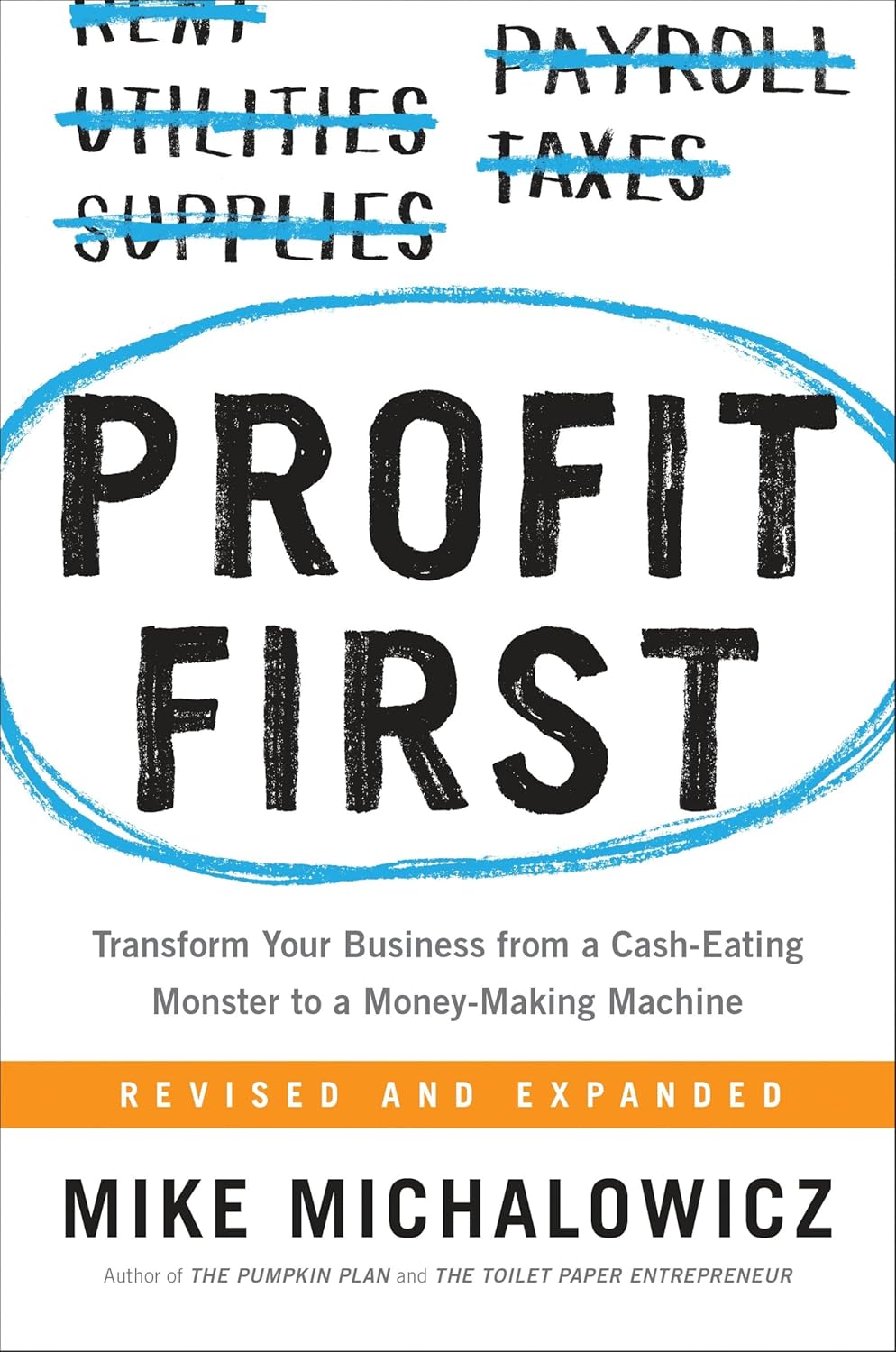
Profit First
An M3 Weekly Book Review
In missional enterprise, we seek to achieve a triple bottom line: making a profit, making disciples of Jesus, and making a difference in our communities. While profit is often listed first, we do not consider it the most important aspect of the triple bottom line. At the same time, many missional enterprises struggle because they fail to prioritize financial sustainability.
In his book Profit First, Michael Michalowicz offers a compelling argument for making profit a much higher priority in the businesses we lead.
Michalowicz introduces one central claim: most businesses think about revenue, expenses, and profit backwards.
Traditional accounting is commonly summarized with the formula:
Revenue – Expenses = Profit
This approach communicates the idea that we first determine our revenue, then pay whatever expenses arise, and finally treat whatever is left over, if anything, as profit.
Michalowicz argues that this thinking is fundamentally flawed. He flips the formula:
Revenue – Profit = Expenses
In other words, reserve profit first, and then limit expenses to what remains. He presents this approach as a way to “transform your business from a cash-eating monster into a money-making machine.”
The book presents four core principles of the Profit First approach, illustrated through the metaphor of healthy eating:
- Use Small Plates: Just as using a smaller plate can help limit how much food we eat, limiting the amount of money available for operating expenses helps control business spending.
- Serve Sequentially: Healthy eating improves when we start with the foods richest in nutrients. In the same way, profit must be removed first from incoming revenue if it is truly going to become a priority.
- Remove Temptation: If we want healthier eating habits, we probably should not stock the pantry with Costco-sized boxes of Twinkies. Likewise, Michalowicz argues that profit should not merely be a spreadsheet category; it should be kept in a completely separate bank account.
- Enforce a Rhythm: Healthy eating depends on consistent habits. Michalowicz encourages business leaders to establish regular rhythms for transferring money into separate accounts, recommending the 10th and 25th of each month.
Specifically, the Profit First method recommends separate bank accounts not only for profit, but also for owner’s compensation, taxes, and operating expenses. Some of these accounts, he suggests, should even be intentionally difficult to access.
At its core, the Profit First concept is simple: pay yourself (and your business profit) first, and then build systems that enforce that principle.
The author observes that most business owners already make spending decisions based primarily on the balance they see in their bank account. Rather than fighting that instinct, Profit First attempts to use it to our advantage.
Who might benefit from this book? Almost any business owner would likely gain something from the principles Michalowicz lays out, even if they do not adopt the full system. Others may decide to embrace the method completely. It should be noted that the author himself strongly encourages readers not merely to adopt the ideas in the book, but to implement the total system in order to experience its full benefits.
The book has been highly recommended by several leaders in the entrepreneurial world, including Verne Harnish, author of Scaling Up.
For missional enterprise leaders, you will not find a discussion of the second and third dimensions of the triple bottom line in this book. What you will find is a practical, well-written, and often humorous primer on at least one approach to building a business that consistently generates profit, and therefore has the capacity to sustain mission over the long term.1
Verse of the Week
“For which of you, desiring to build a tower, does not first sit down and count the cost, whether he has enough to complete it?”Luke 14:28 (ESV)
While Jesus was addressing the cost of following him in this passage, he was drawing on the common-sense wisdom of keeping a discerning eye on the expenses of our endeavors. May God equip us to use well the resources he’s given to build resilient missional enterprises.